
Build Efficient. Build Flexible. Build Future Ready.
Panasonic Intelli Balance® Elite Plus ERVs help builders streamline installation, reduce construction costs, and meet high energy efficiency standards.
Why Builders Choose Panasonic ERVs
Designed for High‑Efficiency Homes
-
High-SRE performance contributes to meeting SB‑12, ENERGY STAR®, and Net Zero requirements by lowering heating loads and improving modeled energy performance.
Two (2) MERV-13 filters included.
-
A ≈90% SRE ERV reduces annual energy consumption by an estimated 1–2 GJ through decreased space-heating demand.*1
-
The ERV’s performance margin allows builders to reduce or remove select envelope or mechanical components under approved performance‑path trade‑offs.
-
As energy codes evolve toward tiered performance (e.g., NBC 2025 Tiers 1–5), high-SRE ERVs can help meet higher performance targets.
-
Two (2) powerful ECM motors with Smart Flow® technology ensure balanced airflow by overcoming static pressure to effectively remove stale air from the home and replace it with fresh air from outside.
-
The unit supports ceiling, wall, floor, or suspended mounting and includes reversible ports to accommodate varying layouts with a single SKU.
The ERV design eliminates the need for a condensate drain or pump, allowing broader placement options and reducing installation complexity.
-
The ERV regulates heat and moisture transfer, supporting consistent indoor humidity levels and protecting building materials.
Reduce Construction Costs With Trade Off Flexibility
Panasonic’s ≈90% SRE ERVs create enough performance margin to reduce builder material or mechanical costs.
NOTE: Energy impacts were estimated using HOT2000 modeling for a representative home. The modeled comparison evaluates a baseline 75% SRE HRV against a high-efficiency ERV with ≈90% SRE.
OBC SB 12 Performance Path Cost Offsets
| Column Header | Column Header | Column Header |
|---|---|---|
| Row Title | Table Row Cell | |
| Row Title | Table Row Cell | |
| Row Title | Table Row Cell | |
| Row Title | Table Row Cell |
OBC SB 12 Performance Path Cost Offsets
| Trade-off | Description | Equivalent Cost Offset*1 per Home |
|---|---|---|
| 1 | Removal of Drain Water Heat Recovery (DWHR) unit | $755 |
| 2 | Reduce attic insulation from R-60 → R-50 | $219 |
| 3 | Reduce above-grade wall cavity insulation from R-22 → R-19 | $355 |
| 4 | Combined attic (R-60 → R-50) + wall (R-22 → R-19) | $574 |
ENERGY STAR® v17.1 Equivalent Performance Value
| Trade-off | Description | Equivalent Cost Offset*1 per Home |
|---|---|---|
| 1 | ENERGY STAR® Zone 3 Windows | 15 – 22% Savings*2 |
| 2 | Level 2 Airtightness (Attached: 2.5 ACH, Detached: 2.0 ACH) | $750 - $1,000 |
| 3 | Instantaneous Condensing Water Heater (min. UEF 0.95) or Combined Space & Water Heating System (TPF ≥ 0.98) | $1,950 - $5,540 |
| 4 | Drain Water Heat Recovery (DWHR) ≥ 54% (two showers) | $755 |
Featured Models
-
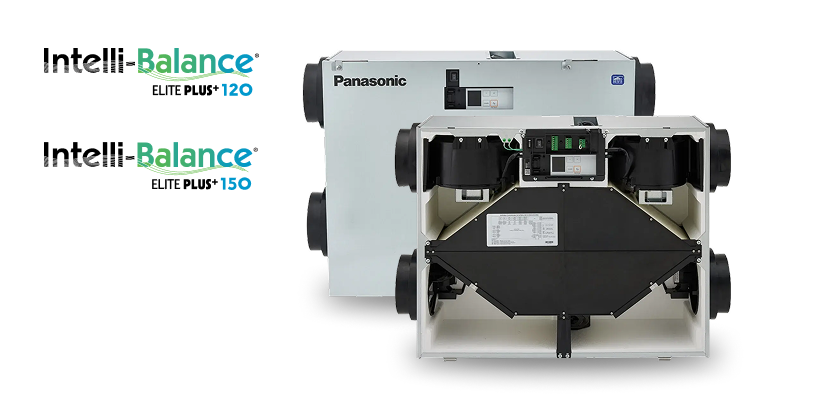
Intelli Balance® Elite Plus 120 & 150
The Intelli-Balance® Elite Plus Energy Recovery Ventilator (ERV) series is ideal for multi-family units and new home build constructions.
Disclaimers
-
Cost offsets are estimates based on NRCan LEEP CBAT (Builder Line Items) for representative case study home (Two-storey single detached with full-height basement; Toronto, Ontario (Zone 1); heated floor area 2,306 ft.). Actual project outcomes will vary with design, construction quality, occupancy, equipment selection, and operating conditions.
-
Based on market research with mid to large production home builders in Ontario. Actual project outcomes will vary with design and procurement conditions.